Archive for August, 2007

Powdery mildew on pumpkin leaves

This is one fast growing crop that I didn’t intend to grow. I think I “bought” this problem of powdery mildew when I did a foliar spray with some fish emulsion that was then followed by multiple damp dark gloomy depressing sunless days.

Within a week, it has really done a number on my vine crops.

It doesn’t really upset me because this represents a teachable moment. My family will not starve due to a reduced number of spaghetti squash and mini-pumpkins and I will, hopefully, learn something about how to cope with powdery mildew.

Lesson #1: Once it starts, its not going away so you have to “deal” with it if you do not want it to spread everywhere.

Lesson #2: It might start in the shade but it will be happy spreading to sunny locations.

While searching for an organic way of dealing with this problem I came across this paper by Crisp, Wicks, Troup, and Scott called “Mode of action of milk and whey of in the control of grapevine powdery mildew” (PDF format) in the journal called Australasian Plant Pathology, published in 2006 (Australasian Plant Pathology, 2006, 35, 487–493).

Powdery mildew takes out all sorts of crops and can be especially vicious to wine grapes. Control of powdery mildew in wine grapes has been done by spraying with sulfur containing fungicides. This is why wines are contaminated with sulfites (and why I can not drink wine, I am violently allergic to these sulfites).

Its been known for some years that spraying a 10% skim milk or whey solution on affected plants is very effective in the treatment of powdery mildew.

This paper reports that sunlight interacts with the milk to form oxygen free radicals that collapse the hyphae of the organism grapevine Erysiphe (Uncinula) necator which we call powdery mildew (zucchini is effected by Sphaerotheca fuliginea). It also damages the conidia (asexual, non-motile spores of a fungus) within 24 hours of treatment.

Some people use hydrogen peroxide, a rich source of oxygen free radicals, but this paper reports that H2O2 doesn’t do anything to the conidia and that it encourages germination of this fungus.

Interesting huh?

Must be that the free radicals produced by photo-oxidation of something in the milk acts by a different mechanism than the free radicals in hydrogen peroxide. Or does it?!

The answer lies in complexity. Read on.

When they looked at a specific component of milk called lactoferrin (a globular multifunctional protein with antimicrobial activity (bacteriocide, fungicide - WIKI, an 80 kDa iron-binding glycoprotein, binds to the membranes of various bacteria and fungi, causing damage to membranes and loss of cytoplasmic fluids - paper), a part of the innate defense, conidia were ruptured but hyphae were not effected until 48 hours out.

This indicates, as per these authors and seems intuitive, that milk has a bipartite action against powdery mildew:

  • photo-induced free radical activity
  • lactoferrin mediated rupture of conidia

The authors close by saying that the mechanism by which lactoferrin is effecting the conidia is not clear. They also think that there many be other parts of milk which could be having an anti-mildew effect.

I will be spraying my unfortunate mildew-infested plants with a 10% skim milk solution (shown below) and I will let you know how it goes!

Drop me a comment if you have had success with this method.

Measure a 1:10 milk:water solution into a sprayer. I am using skim now but I might try a whole fat to see if there might be some fat-soluble or fatty acid aspects. I might even use raw if all else fails!

If I were being scientific about this, I would leave a section unssprayed, spray one section each of - skim, whole commercial, whole raw. This is not scientific, its going to be anecdotal and descriptive and with no controls because I started out just desperate to attack the problem so I do not have any untreated plants right now.

As I am not a mycological physiologist and I am not working of a government grant, I think its going to be ok.

Pour in the milk.

Pour in the water, mix it all up in a bucket.

Spray on a SUNNY DAY, not cloudy.

Watch.

Spray twice a week.

Watch.

Blog.

Lets hope I can see SOME result otherwise there will be no follow up to this post and you will be left hanging!
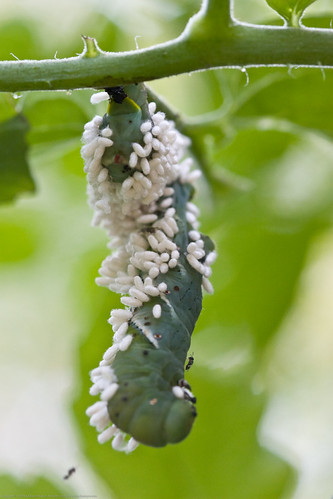
In one of my many-a-day strolls through the garden, I was looking at one of the tomato patches, lamenting the loss of most of the leaves on my calabash tomato to some sort of wilt (I hesitate to says its one thing, I am guessing various things are going on here) and I found, hanging from a tomato branch, this caterpillar beset by eggs and what looked like flying ants.

My first reaction was revulsion (OK, that remains my reaction) but I left it there because:

  1. I could not help myself with wanting to take a shot,
  2. I knew that someone over at the flickr group “ID Please” would be able to help me identify these two creatures (flies and caterpillar1) and
  3. I had a sneaking suspicion that something so revolting must be good some how (just like when I see an antique .. if I find it hideous it is bound to be expensive and in demand … like a reversed fashion compass of sorts)

My friends Mean and Pinchy and aw c’mon at flickr helped my identify this as a tomato2 hornworm (Five-Spotted Hawkmoth - Manduca quinquemaculata) being consumed by braconid wasp3s, a VERY good thing. Once these wasps hatch they can go on and parasitize4 more hornworms.

From the wiki entry on braconids, relating to their parasitism:

“Most braconids are primary parasitoids (both external and internal) on other insects, especially upon the larval stages of Coleoptera, Diptera, and Lepidoptera, but also some hemimetabolous insects like aphids, Heteroptera or Embiidina. Most species kill their hosts, though some cause the hosts to become sterile and less active. In the case of endoparasitoids, species often display elaborate physiological adaptations to enhance larval survival within host, for example the co-option of endosymbiotic5 viruses for compromising host immune defenses. These polydnaviruses are often used by the wasps instead of a venom cocktail. These viruses suppress the immune system and allow the parasitoid6 to grow inside the host undetected. The exact function and evolutionary history of these viruses are unknown. It is a little surprising to consider that sequences of polydnavirus genes show the possibility that venom-like proteins are expressed inside the host caterpillar. It appears that through evolutionary history the wasps have so highly modified these viruses that they appear unlike any other known viruses today. Because of this highly modified system of host immunosuppression7 it is not surprising that there is a high level of parasitoid-host specificity. It is this specificity that makes Braconids a very powerful and important biological control agent.

Parasitism on adult insects (particularly on Hemiptera and Coleoptera) is also observed. Members of two subfamilies (Mesostoinae and Doryctinae) are known to form galls on plants.”

So these hymenoptera order members are in good in my book. I will just have to look the other way cause they make me nauseous!

Here are a couple shots of a couple of my tomato plants are seem to have a wilt. This first one is a calabash tomato plant with MANY fruits.

The fruits look fine and so many and so heavy that they need to be braced or the branch gets very stressed (see photo)

This is a different tomato (small salad tomatoes)

This also has abundant numbers of small cherry like tomatoes.

I took some new shots of the whole garden today and it seems to become this sort of embarrassing overgrowing crazy green entity! Makes one think of a green version of tribbles.

If you have any ideas of how best to minimize this wilt business next year, I would love to hear it. I plan on planting each tomato far from it’s neighbors and give them abundant space.

I am also definitely going to plant tomatillo8s again (and more, disbursed everywhere) because they bring in the bees like crazy, very good for pollination9.

~~Definitions~~
1 caterpillar
Definitions
  1. the elongated wormlike larva of a butterfly or moth
  2. any of various similar larvae
Pronounciation: ˈka-tə(r)-ˌpi-lər
Function: noun
Usage: often attributive
Date: 15th century
Etymology: Middle English catyrpel, from Anglo-French *catepelose, literally, hairy cat

2 tomato
Definitions
  1. the usually large rounded typically red or yellow pulpy berry of an herb (genus Lycopersicon) of the nightshade family native to South America
  2. a plant that produces tomatoes
  3. one (Lycopersicon esculentum syn. L. lycopersicum) that is a tender perennial widely cultivated as an annual for its edible fruit
Pronounciation: tə-ˈmā-(ˌ)tō; chiefly British, eNewEng, neVirginia, and sometimes elsewhere in cultivated speech -ˈFunction: noun
Date: 1604
Etymology: alteration of earlier tomate, from Spanish, from Nahuatl tomatl

3 wasp
Definitions
  1. any of numerous social or solitary winged hymenopterous insects (especially families Sphecidae and Vespidae) that usually have a slender smooth body with the abdomen attached by a narrow stalk, well-developed wings, biting mouthparts, and in the females and workers an often formidable sting, and that are largely carnivorous and often provision their nests with insects or spiders killed or paralyzed by stinging for their larvae to feed on — compare bee
  2. any of various hymenopterous insects (as a chalcid or ichneumon wasp) other than wasps with larvae that are parasitic on other arthropods
Pronounciation: ˈw?sp, ˈwsp
Function: noun
Date: before 12th century
Etymology: Middle English waspe, from Old English w?ps, w?sp; akin to Old High German wafsa wasp, Latin vespa wasp

4 parasitize
Definitions
  1. to infest or live on or with as a parasite
Pronounciation: -sə-ˌtīz, -ˌsī-
Function: transitive verb
Date: circa 1890
5 endosymbiotic
Definitions
  1. symbiosis in which a symbiont dwells within the body of its symbiotic partner
Pronounciation: ˌen-dō-ˌsim-bī-ˈō-səs, -bē-
Function: noun
Date: circa 1940
6 parasitoid
Definitions
  1. an insect and especially a wasp that completes its larval development within the body of another insect eventually killing it and is free-living as an adult
Pronounciation: ˈper-ə-sə-ˌtid, -ˌsī-, ˌpa-rə-
Function: noun
Date: 1922
7 immunosuppression
Definitions
  1. suppression (as by drugs) of natural immune responses
Pronounciation: -sə-ˈpre-shən
Function: noun
Date: 1963
8 tomatillo
Definitions
  1. the small round yellow, purplish, and especially pale green edible sticky fruit of a Mexican ground-cherry (Physalis ixocarpa syn. P. philadelphica)
  2. the plant that bears tomatillos
Pronounciation: ˌtō-mə-ˈtē-(ˌ)yō, -ˈtēl-(ˌ)y
Function: noun
Date: circa 1913
Etymology: Spanish, diminutive of tomate

9 pollination
Definitions
  1. the transfer of pollen from an anther to the stigma in angiosperms or from the microsporangium to the micropyle in gymnosperms
Pronounciation: ˌp?-lə-ˈnā-shən
Function: noun
Date: 1875