
I hope all is well with you all!
I have included here a bit of audio – sort of a meditation on – saving seeds from garlic chives.
I hope all is well with you all!
I have included here a bit of audio – sort of a meditation on – saving seeds from garlic chives.
(This was cross-posted to Nika’s Culinaria and Peaknix)

We are enjoying our independence from the food chain. We get our eggs and our milk (and now cheese) from our backyard. We eat our salads from our backyard.
If you don’t now, what are you waiting for?!
If you think food prices are high now, you will be pale with shock soon enough. Think oil-based fertilizers, oil-based pesticides, oil-run tractors and trucks, think floods, think drought, think 2008.

The seed companies are reporting a 40% rise in seed sales this year (they were shocked, didn’t see it coming, these people need to get on the web more often).
Now that the baby goats are not such babies and are fully weaned, we have more goat milk to work with. We go through less than 1 gallon of fluid goat milk a day for Baby O (who adores goat milk and is sensitive to lactose in pasteurized cow milk).

Our milking doe, Torte, gives us about one and 1/2 gallons of milk a day. Over two days, we then have one extra gallon of milk, works out nicely.

You may or may not know that it is hard to make cream or butter from goat milk because the fat doesn’t separate out (because the fat globules are smaller and stay spread out, like its been homogenized). We could make it if we bought a $400.00 cream separator but thats not going to happen! I love goat cheese just fine.

We will be getting a jersey cow/calf to have super high quality milk, cream, and butter. I can wait for that.
Back to the topic for today.
It is VERY easy to make chevre but it takes a few days, you simply have to be patient.
We are using milk we pasteurized for this batch, we may go raw with he next batch.
We used a chevre starter from the New England Cheesemaking Supply Company, I can not recommend them highly enough.

This little packet is enough for one gallon of milk. This could not be easier, you just bring your milk up to (or down to as the case may be) to 86 F and sprinkle the starter in. Mix well and let culture at room temperature for 12-20 hours.
The curd sets up and excludes the whey.
You then slice it up a bit so that the mass of curd is broken up and more whey is excluded.
Remember that all of the equipment being used must be sterilized.
We bought the plastic chevre molds from the New England Cheesemaking Supply Company which I cleaned very well.
These are well worth the cost and will last a long time.

Using a sterilized slotted spoon, you scoop out the curds and begin to fill the molds.


One gallon of milk yielded three molds worth of cheese.


Once they are filled they go on a wire rack over a pan or bucket to catch the dripping whey, cover the tops and let sit at room temperature or in the fridge for 2 days. They will shrink a lot.

After the two days, the cups were no longer dripping and the cheese was quite firm and much dryer.

This cheese tastes unbelievably fresh and, I think, uniquely ours. Its a fantastic feeling to sit down to a salad that we grew topped with chevre we made from our own goat. I watched Torte munching on tree bark in our backyard as I nibbled on the cheese.
Resources:
First, a thought that I felt was noble, something to aspire to:
“So stop perching on your shoulders peering out from behind your eyes and sit down. And when you stand, stand forth from the haunted and dead thoughts of the past and idle and wasteful speculation about the future and take a step.” * see bottom of this post.
I usually load up my iPod with various zen teishos (podcasts) and walk about the garden in the cool of the morning listening to the zen masters without having to sit on my legs (an impossibility, I would throw a clot in no time). This is suboptimal because teisho is best after sitting at least some 45 minutes but its still a good thing to do. Sometimes I do wonder about the discordant dichotomy between my pondering the universal dharma and the preciousness of all beings while pulling weeds, killing flights of aphid babies and beetles, and pruning various plants. My sole justification is that I am growing this garden for my family, not for the ravenous bugs. Its the right justification but it still gives me pause as I consider the tenet of doing no harm.
As with the realities that most women have to live with, I come to terms with the needed death decisions in my garden but I do it first hand, by hand, and not in the disconnected way with pesticides.
Today I was admiring the way the kohlrabi plants had burst into growth but then when I looked more closely I noticed this little beetle you see below. He sure is pretty but he is also an eating machine. He has eaten several plants to nothing and has hit almost all the rest.
This photo? It was his last.

When I planned out my garden, I bought seeds that were not the usual thing you might see in a traditional New England garden (I am sure not a traditional New Englander, considering I was born at the Equator, in a far away land). One plant is doing MUCH better than I thought it would. Do you know what this plant is? There are several photos below.

and this..

and this..

If you know, drop me a comment!
The entire garden is surging into a green frenzy. Its abundance is hard to capture by camera but here is an attempt.
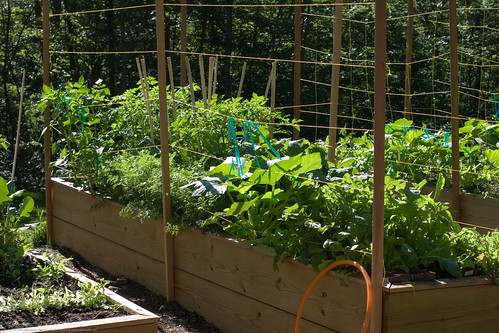
The tomatoes are blooming. I know that many other people have plants laden with fruits but we started late so we are happy with anything we get.

The cucumber plants have little infant cucumbers with tiny nascent blossoms.
This photos was taken yesterday.

This photo was taken today, the difference is amazing.

Our entire patch of spinach had been planted at the same time and it was also all starting to bolt at the same time so yesterday I pulled it all.

We steamed it, chopped it up and added hot heavy cream, salt, some pepper. Was delicious. We had many green spinach salads from the same patch over the past weeks. This spinach was just so productive!
* Ven. Anzan Hoshin roshi, concluding teisho 5: “Actualizing the Samadhi of Dharmata” in the series “Essentially Real, commentaries on Eihei Dogen zenji’s Hossho: Dharmata”. Presented on Tuesday, December 7, 2004 at the White Wind Zen Community Zendo in Ottowa, Ontario, Canada. See their site to learn more about zen and their sangha.

I learned recently that our neighboring town has a farmer’s market starting up (on Saturdays) and I have looked into what it takes to sell there. I am a bit worried that some of the crops we planted may overwhelm our capacity to eat them and this Saturday market would be a good way to profit from the overproduction. Its entirely possible that I am being overly optimistic but better to be prepared than caught off guard. Come to think of it, I do not know how best to price produce so that I am not undercutting or pricing myself out. Anyone have any good guidelines?
I put together the logo you see above as a brand for any veggies we may sell at the market. We will print it out onto stickers which I will then apply to bags at the time of sale. I used the euphemism “Grown Pure” because I didn’t want to have to remove “Organic” at a later date. I understand that if you make less than $5000 a year, you can call yourself organic (if you ARE organic) without the certification. We are going to go through that process. Am going to be joining Northeast Organic Farming Association/ Massachusetts (NOFA) and also attend their conference this summer. Should be a lot of fun and a great way to meet fellow growers.
There are many things going on in the garden since last I wrote. Trellising is going up for climbing beans, snow peas, squashes, watermelons, mini-pumpkins, and zucchinis. We had a pretty windy storm yesterday so some plants had to do be tied up for support. I am not exactly sure why but my cruciferous veggies, like the broccoli and the collards are really leggy but do not want to quit so they just have this really weak elbow bend where they came out of the soil. I staked the broccoli so that they get some support and I hope that they produce. Did I water them too much? These were seeded right into the bed on and around May 24th.
We have been cutting mesclun to eat and it grows right back. The spinach is the same but it is REALLY abundant! We cut and cut but they just grow back even more vigorously. Some of them didn’t like the 96 F weather last week so I think they are on the verge of bolting. Good thing is that it has cooled off a lot. Now its humid, mid 70s and abundant rain (tho a bit rough at times).
The first batch of radishes that were planted are getting to the final pickings. Here are a few photos for your food porn purposes.

Bundle of red globes.

The radishes slice up nicely, are crispy and sweet at first with a medium and not harsh hot after-taste.
My bell peppers are starting to bloom (there are other pepper plants that are sequenced later so we have a couple sets of those) and the tomatillos are budding too. The cayenne are taking their sweet time! I dont think they like our mild weather.
The wood shed – to – chicken house connecting deck is almost done and then we will start on the chicken house. We are still debating how many to get :-/.
I am working on what MIGHT be an exciting project that will bring in organic fertilizer to help us maintain and boost our soil fertility.

I just wanted to share with you our first salad. Our first batch of mesclun is ready to be eaten, the radishes are plumping up, and the baby spinach is tender and delicious!
Am about ready to seed in the third succession crop of both radish and mesclun.


Activate the Wp-cumulus plugin to see the flash tag clouds!





We are a family of 5, including Nika, Ed, Q (14), KD (7), and Baby Oh (4). We garden 1024 square feet of raised beds plus assorted permacultural plantings. We also have 13 LaMancha dairy goats, 40 chickens, and one guard llama.
