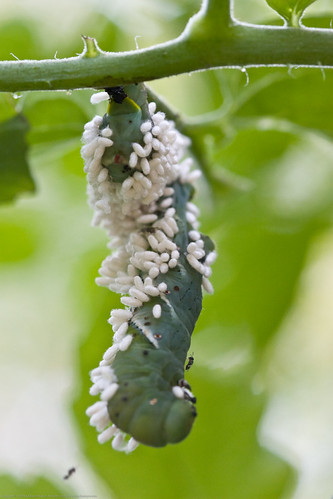
In one of my many-a-day strolls through the garden, I was looking at one of the tomato patches, lamenting the loss of most of the leaves on my calabash tomato to some sort of wilt (I hesitate to says its one thing, I am guessing various things are going on here) and I found, hanging from a tomato branch, this caterpillar beset by eggs and what looked like flying ants.
My first reaction was revulsion (OK, that remains my reaction) but I left it there because:
- I could not help myself with wanting to take a shot,
- I knew that someone over at the flickr group “ID Please” would be able to help me identify these two creatures (flies and [[caterpillar]]) and
- I had a sneaking suspicion that something so revolting must be good some how (just like when I see an antique .. if I find it hideous it is bound to be expensive and in demand … like a reversed fashion compass of sorts)
My friends Mean and Pinchy and aw c’mon at flickr helped my identify this as a [[tomato]] hornworm (Five-Spotted Hawkmoth – Manduca quinquemaculata) being consumed by braconid [[wasp]]s, a VERY good thing. Once these wasps hatch they can go on and [[parasitize]] more hornworms.
From the wiki entry on braconids, relating to their parasitism:
“Most braconids are primary parasitoids (both external and internal) on other insects, especially upon the larval stages of Coleoptera, Diptera, and Lepidoptera, but also some hemimetabolous insects like aphids, Heteroptera or Embiidina. Most species kill their hosts, though some cause the hosts to become sterile and less active. In the case of endoparasitoids, species often display elaborate physiological adaptations to enhance larval survival within host, for example the co-option of [[endosymbiotic]] viruses for compromising host immune defenses. These polydnaviruses are often used by the wasps instead of a venom cocktail. These viruses suppress the immune system and allow the [[parasitoid]] to grow inside the host undetected. The exact function and evolutionary history of these viruses are unknown. It is a little surprising to consider that sequences of polydnavirus genes show the possibility that venom-like proteins are expressed inside the host caterpillar. It appears that through evolutionary history the wasps have so highly modified these viruses that they appear unlike any other known viruses today. Because of this highly modified system of host [[immunosuppression]] it is not surprising that there is a high level of parasitoid-host specificity. It is this specificity that makes Braconids a very powerful and important biological control agent.
Parasitism on adult insects (particularly on Hemiptera and Coleoptera) is also observed. Members of two subfamilies (Mesostoinae and Doryctinae) are known to form galls on plants.”
So these hymenoptera order members are in good in my book. I will just have to look the other way cause they make me nauseous!
Here are a couple shots of a couple of my tomato plants are seem to have a wilt. This first one is a calabash tomato plant with MANY fruits.


The fruits look fine and so many and so heavy that they need to be braced or the branch gets very stressed (see photo)
This is a different tomato (small salad tomatoes)

This also has abundant numbers of small cherry like tomatoes.

I took some new shots of the whole garden today and it seems to become this sort of embarrassing overgrowing crazy green entity! Makes one think of a green version of tribbles.

If you have any ideas of how best to minimize this wilt business next year, I would love to hear it. I plan on planting each tomato far from it’s neighbors and give them abundant space.
I am also definitely going to plant [[tomatillo]]s again (and more, disbursed everywhere) because they bring in the bees like crazy, very good for [[pollination]].







Hi Nika! I love your riotous garden! Absolutely gorgeous! I had a hornworm problem as well this year, but luckily for me I accidentally let my cilantro plants go to seed. I was not familiar with how easily they bolt in hot weather, and suddenly these long stalks of tiny white flowers were blooming away. Well, guess what attracts those parasitic wasps? I did a little research and found out that they happen to love the blooming cilanto. It was only a short buzz over to my tomatoes, and soon the hornworms were history. Thank goodness I only had to pick a few and squish them – the wasps took care of the rest! So next year I will plant cilantro for my cooking use, and plenty extra to go to seed near the tomatoes.
I also had a wilt problem; this year’s garden has taught me an abundance of lessons. My mistakes were planting too closely, so not enough air circulation between plants, and splashing water on the plants. Next year lots of room and a drip system. I have also read not to plant tomatoes in the same plot for 3 years, and not to compost the diseased tomato vines, burn them or throw them out in the garbage. It is a soil-borne disease, and will infect next years crop.
Tomatillos sound good – I think you have inspired me to try them next year! Have you had any experience with rock dust as a soil amendment? I’ve been reading about it on the Path to Freedom website, it sounds intriguing.
Ingrid: thanks! Wild about the cilantro. I looked up companion planting for tomatoes when I was planting the garden and didnt come across cilantro (I planted that somewhere else) bu that doesnt mean its not supposed to grow there! Sounds like its a great thing to grow. I grew parsley and oregano and basil and the base of the tomatoes.
I too have learned so much! I used a dripper hose and tried hard not to spray the branches.
next year i am keeping my seeds of change tomatoes FAR from ones bought elsewhare. I will also space better, like you.
I have read about “rock dust” at PTF and elsewhere but did not pay enough attention on what it is and why to use it. Will look in to it too!
What a gorgeous, verdant garden! I hope to have one as large as that next year. Will keep the tip for companion planting cilantro with tomatoes. I have a lot of assorted flowers in the garden currently (marigolds, calendula, cosmos, broccoli gone to flower, sunflowers) and had noticed almost no harmful insects at all. Pretty nice, especially since I’ve been neglecting the plot far too often lately.
Kathy: Glad you like it! Yeah, I definitely need to have a lot more cilantro in my life next year I love it so much I could eat it as a salad almost.
It seems that the greater diversity and definitely the greater “bloomage” you have going on the better you are with the good bugs.
We even have hummingbird who come to sip out red flowered beans. Its neat to stand below the red flowers ad watch the hummers sip with no care for me being so close.
Be sure to crush up your egg shells after they’ve dried and sprinkle around your tomatoes. Calcium dificency (spelling!) causes many issues and makes things more suseptible to attack.
Honey